FeaturedComputer Vision
AgroPest-12 Insect Detection and Classification Benchmark
Benchmarked classical, hybrid, and deep learning pipelines for 12-class agricultural pest detection and classification, measuring both predictive performance and runtime behavior on fixed data splits.
Summary
Project context
A group computer vision benchmark comparing insect detection and classification methods on the AgroPest-12 dataset.
Problem / goal
Agricultural monitoring needs models that can detect small, low-contrast, and camouflaged insects while remaining accurate and practical enough for timely use.
My role
Computer Vision Developer on a group benchmark project.
What I personally contributed
- Implemented and compared HOG/SIFT-BoVW/SVM, YOLOv8 and EfficientNet-B0, YOLOv11n, YOLOv12n, and Faster R-CNN with ResNet50-FPN.
- Evaluated fixed train, validation, and test splits with mAP@50, mAP@50:95, accuracy, precision, recall, F1-score, ROC-AUC, latency, and FPS.
- Analyzed failure cases involving small, low-contrast, and camouflaged insects to explain model tradeoffs beyond headline metrics.
Technical approach
- Established comparable data splits and evaluation criteria across classical feature pipelines, hybrid classifiers, and modern detectors.
- Measured detection, image-level classification, and runtime behavior with task-appropriate metrics.
- Used qualitative error review to connect false detections and missed insects to scale, contrast, and camouflage.
Key features
- Classical, hybrid, and deep learning model comparison.
- Detection and image-level classification evaluation.
- Latency and FPS analysis alongside accuracy metrics.
- Failure analysis for difficult insect imagery.
Impact / results
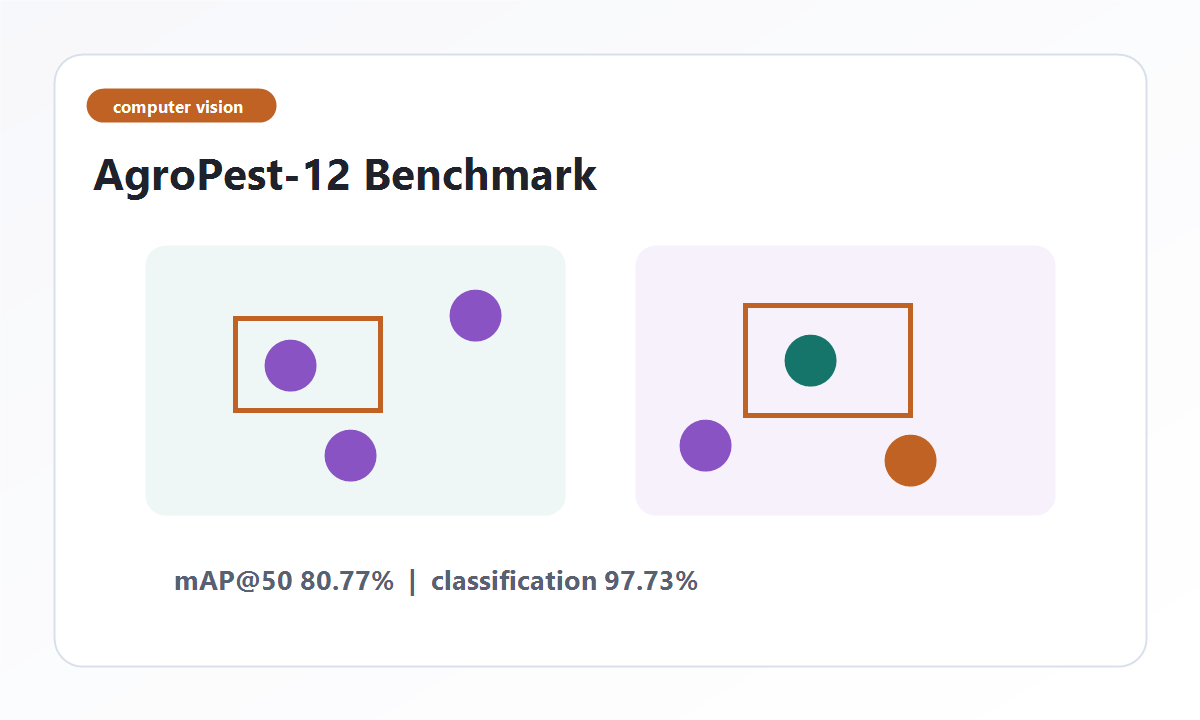
- YOLOv11n achieved 80.77% mAP@50 for detection and 97.73% image-level classification accuracy on the test set.
- Documented accuracy, runtime, and failure-mode tradeoffs across the evaluated model families.
What I learned
- Strong aggregate metrics can hide systematic failures on small or camouflaged objects.
- A benchmark is more useful when accuracy, speed, and qualitative failure modes are interpreted together.